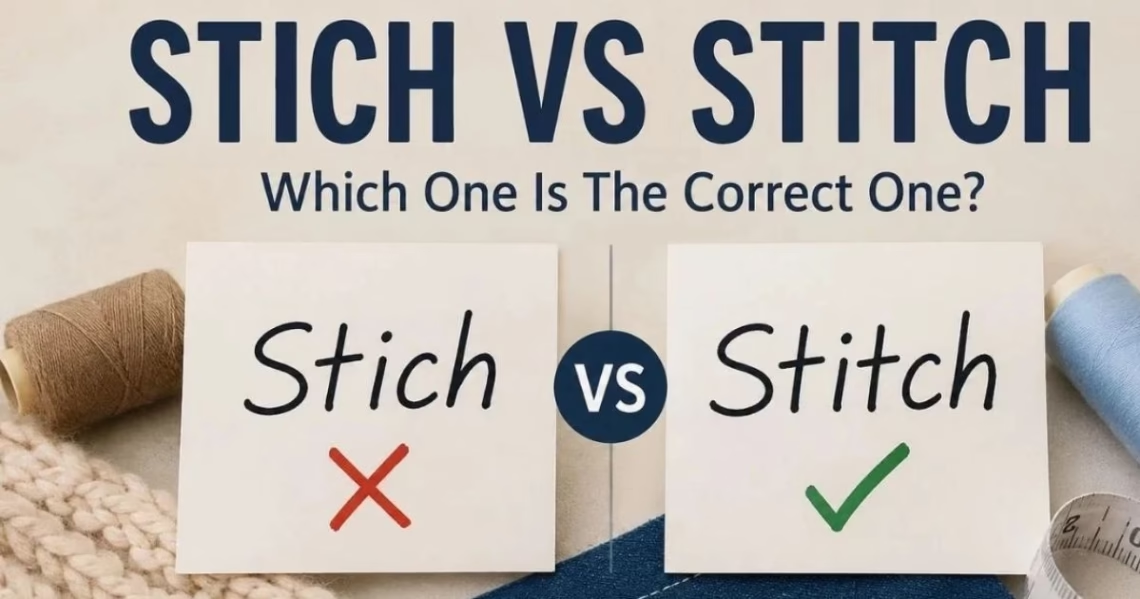
The word “stich” often appears when people search for the correct spelling of “stitch.” Because both words look almost identical and are pronounced similarly in some contexts, it is easy to confuse them while writing messages, completing school assignments, creating content, or discussing sewing and medical treatment. However, understanding their meanings makes it much easier to choose the right word.
In modern everyday English, “stitch” is the correct spelling for sewing, knitting, embroidery, repairing fabric, and closing wounds with medical sutures. The word “stich” also exists, but it has a rare literary meaning related to a line of poetry. It is also frequently used as a misspelling of “stitch.”
This guide explains the meaning of stich, the difference between stich and stitch, correct spelling rules, pronunciation, sentence examples, common mistakes, and practical ways to remember the correct form. Whether you are a student in India, a writer in the United States, an English learner, or someone simply looking for a quick answer, you will find the information you need below.
What Does Stich Mean?
The meaning of “stich” depends on the context in which it appears. In ordinary writing, it is usually a spelling mistake made when someone intends to write “stitch.” However, the term has a legitimate but uncommon meaning in literary and academic language.
In discussions of poetry, a stich can refer to a line or verse. This specialized meaning is associated with literary analysis and the study of poetic structure. Most people do not encounter it in everyday conversations because the word is mainly relevant to particular academic subjects.
For example, a literature student might encounter the term while studying the structure of ancient poetry. In this situation, “stich” can be appropriate because the writer is using the word in its specialized sense.
Outside such contexts, however, the spelling is generally incorrect when the intended meaning concerns sewing, clothing, embroidery, knitting, or medical treatment.
Consider these examples:
- Incorrect: She used a stich to repair the torn shirt.
- Correct: She used a stitch to repair the torn shirt.
- Incorrect: The doctor placed three stiches in the wound.
- Correct: The doctor placed three stitches in the wound.
These examples demonstrate why context matters. The shorter spelling is not automatically wrong in every possible situation, but it is not the standard spelling for the common meanings of “stitch.”
If you are unsure which word to use, consider the meaning you want to communicate. When your sentence refers to thread, fabric, a needle, a wound, or a sharp pain in the side, choose “stitch.”
What Does Stitch Mean?
“Stitch” is a standard English word that can function as both a noun and a verb. Its meaning changes slightly according to the situation, but its central idea often involves joining, forming, or repairing something.
The word is commonly used in sewing, knitting, crochet, embroidery, healthcare, exercise, and everyday conversation.
Stitch as a Noun
As a noun, a stitch can describe a single movement of a needle through fabric or the loop of thread created by that movement. In knitting and crochet, it can refer to a loop of yarn formed with needles or a hook.
The word also has a medical meaning. Doctors use stitches, also called sutures, to bring the edges of certain wounds together. In another common usage, a stitch is a sharp, localized pain that someone may experience in the side during physical activity.
Examples include:
- My grandmother taught me how to make a neat stitch.
- The sweater pattern requires forty stitches in the first row.
- The doctor used several stitches to close the cut.
- I developed a stitch in my side while running.
- The tailor checked every stitch before delivering the suit.
In each sentence, the word refers to a specific object, action-related unit, or physical sensation.
Stitch as a Verb
As a verb, “stitch” means to join, repair, or decorate material using thread. It can also describe closing a wound with medical sutures.
Examples include:
- I need to stitch the loose button back onto my shirt.
- She learned to stitch beautiful designs onto cotton fabric.
- The tailor will stitch the new sleeves onto the jacket.
- The medical team stitched the wound after examining it.
- He stitched the torn pocket carefully so it would last longer.
The past tense is “stitched,” and the present participle is “stitching.” The plural noun is “stitches.”
Learning these forms helps prevent additional spelling mistakes, particularly when writing longer sentences or explaining an action.
Stich vs Stitch: What Is the Main Difference?
The main difference between “stich” and “stitch” is their standard usage and meaning. “Stitch” is the normal modern English word used in everyday communication, while “stich” is uncommon and usually appears as a misspelling or in specialized literary discussions.
The following comparison makes the distinction easier to understand.
| Feature | Stich | Stitch |
| Standard everyday spelling | Generally incorrect for common meanings | Correct |
| Sewing and tailoring | Usually a misspelling | Correct |
| Knitting and crochet | Usually a misspelling | Correct |
| Medical sutures | Usually a misspelling | Correct |
| Pain during exercise | Usually a misspelling | Correct |
| Literary meaning | Can refer to a line of verse | Not the same specialized term |
| Verb form | Not the standard form for sewing | Stitch |
| Past tense | Stiched is incorrect for the intended sewing meaning | Stitched |
| Plural | Stiches is incorrect for the intended sewing meaning | Stitches |
The comparison shows that adding the second letter “t” is important when you want to describe sewing, medical sutures, or related everyday meanings.
For example, if you write “The nurse removed the stiches,” readers may understand your intention, but the spelling is incorrect. The correct sentence is “The nurse removed the stitches.”
Likewise, “She stiched the fabric” should be written as “She stitched the fabric.”
The simplest rule is to use “stitch” unless you have a specific reason to use the rare literary word “stich.”
Is Stich a Real Word or Just a Spelling Mistake?
This is one of the most common questions people ask when comparing these two spellings.
The answer is that “stich” is a real word in a limited context, but it is frequently a misspelling of “stitch” in ordinary English.
The distinction is important because not every unusual spelling is meaningless. Some words survive in specialist fields, historical documents, and academic discussions even when they are rarely used in modern conversation.
When Stich Is a Real Word
In literary terminology, “stich” can refer to a line or verse of poetry. A reader studying poetic rhythm or the organization of ancient verse may encounter this usage.
For example:
“The scholar examined each stich to understand the poem’s structure.”
Here, the term refers to a poetic line rather than a sewn loop of thread. The sentence belongs to a specialized literary context.
When Stich Is a Misspelling
In everyday English, the spelling is usually incorrect when the writer intends to describe sewing, knitting, or medical treatment.
For example:
- Incorrect: I need one more stich to finish this design.
- Correct: I need one more stitch to finish this design.
- Incorrect: The doctor gave him four stiches.
- Correct: The doctor gave him four stitches.
- Incorrect: She is learning how to stich a dress.
- Correct: She is learning how to stitch a dress.
Recognizing the difference allows you to understand unusual uses without accidentally reproducing common spelling errors.
How to Pronounce Stich and Stitch
Pronunciation can contribute to the confusion because the common word “stitch” is pronounced /stɪtʃ/ in standard American and British English.
The final sound resembles the sound at the end of words such as “which” and “switch.” The word contains a short vowel sound, followed by the familiar “ch” sound.
In everyday English, “stich” is often intended to represent the same spoken word, even when the spelling is wrong. However, the rare literary term has its own pronunciation conventions, so a specialist dictionary may be useful when discussing it academically.
For practical communication, focus on remembering the spelling rather than relying only on how the word sounds.
A useful approach is to say the word aloud while picturing its spelling:
S-T-I-T-C-H
The two consecutive letters “t” distinguish the standard spelling from the common typo.
For example, when writing about a tailor repairing clothing, mentally connect the word “stitch” with the needle, thread, and fabric involved in the task. This association can help reinforce the correct spelling.
Why Do People Confuse Stich and Stitch?
There are several reasons these spellings are easy to mix up. Understanding these causes can help you avoid making the same mistake repeatedly.
1. The Words Look Almost Identical
The difference between the two spellings is just one additional letter. When typing quickly, it is easy to overlook the missing “t,” particularly if you are concentrating on the meaning of the sentence rather than its spelling.
This can happen in emails, text messages, social media captions, schoolwork, and website content.
2. Typing Speed Causes Errors
People frequently type without reviewing every word. A small spelling error may remain unnoticed because the sentence still looks understandable.
For example, a writer may type “stich the cloth” instead of “stitch the cloth.” The reader can probably understand the intended meaning, but the mistake can make formal writing look less polished.
3. English Contains Many Double-Letter Words
English spelling includes many words with repeated consonants, such as “little,” “button,” “letter,” and “coffee.” Remembering which words contain double letters can be challenging, particularly for learners who are still building their vocabulary.
“Stitch” is another word that benefits from deliberate spelling practice.
4. Familiarity With Unusual Words Creates Confusion
Someone who encounters the spelling “stich” online may assume it is an accepted alternative. In reality, online appearances can include typos, usernames, product names, and specialist terminology.
A spelling should not be considered standard simply because it appears in a sentence or on a website.
5. Autocorrect Does Not Catch Every Error
Spelling tools can be helpful, but they do not replace careful proofreading. Names, unusual terms, and context-dependent words may not be handled as expected by every keyboard or writing application.
Reviewing the complete sentence remains a useful habit.
Correct Ways to Use Stitch in Sentences
The best way to understand a word is to see how it works in different situations. The following examples demonstrate the standard use of “stitch” across common areas of life.
Stitch in Sewing and Tailoring
In sewing, a stitch is an individual unit of thread used to join pieces of material, repair a tear, or create a decorative pattern.
Examples:
- The tailor added a strong stitch to repair the damaged seam.
- She used a straight stitch to attach the pocket.
- Each stitch must be even for the finished garment to look professional.
- I learned to stitch a button onto my school uniform.
- The designer selected a decorative stitch for the edge of the dress.
When writing about clothing repairs, sewing techniques, or textile work, “stitch” is the appropriate spelling.
Stitch in Knitting and Crochet
Knitting and crochet use loops of yarn to produce fabric, accessories, garments, and decorative objects. Each loop or unit of work may be called a stitch.
Examples:
- The pattern begins with twenty stitches.
- She accidentally dropped a stitch while knitting the scarf.
- This crochet design uses a simple chain stitch.
- The beginner counted every stitch before starting the next row.
- Adding another stitch will make the knitted piece wider.
These examples show how the word is used in craft instructions and conversations about handmade products.
Stitch in Embroidery
Embroidery involves decorating fabric with thread. Different stitch techniques produce different patterns, textures, and visual effects.
Examples:
- She used a cross-stitch pattern to decorate the cushion.
- The embroidery requires small, precise stitches.
- A satin stitch can create a smooth, filled-in area.
- The artist used colorful thread to stitch flowers onto the fabric.
- Every stitch contributed to the final design.
If you are writing a tutorial about embroidery, always use the standard spelling “stitch.”
Stitch in Medical Situations
In healthcare, stitches or sutures are used to close certain wounds and surgical incisions. The word is also used as a verb when describing the procedure of closing a wound.
Examples:
- The doctor examined the cut before deciding whether stitches were necessary.
- The nurse explained how to care for the wound after treatment.
- The surgeon stitched the incision closed.
- The patient returned for a follow-up appointment to have the stitches checked.
- Some sutures dissolve over time, while others need to be removed by a healthcare professional.
Medical usage is another situation in which the distinction matters. Writing “stiches” instead of “stitches” is a spelling error, even if the intended meaning is obvious.
Stitch in Sports and Exercise
The noun “stitch” can also refer to a sudden, sharp pain in the side, often experienced during running or other physical activity.
Examples:
- I developed a stitch in my side halfway through the race.
- The runner slowed down after feeling a sharp stitch.
- She stopped exercising briefly because of discomfort in her side.
- He sometimes experiences a stitch when running immediately after eating.
In this context, the word does not refer to thread or sewing. It describes a physical sensation.
Persistent, severe, or unusual pain should not automatically be assumed to be an ordinary exercise-related stitch.
Stitch in Everyday Expressions
The word appears in several familiar expressions that have meanings beyond literal sewing.
Examples:
- The comedian had the audience in stitches.
- There was not a stitch of clothing left in the suitcase.
- A stitch in time saves nine.
- I would not trust him to do a stitch of work.
These expressions illustrate why understanding the word’s context is useful. The same spelling can communicate different ideas in different sentences.
Common Spelling Mistakes Related to Stitch
The confusion between “stich” and “stitch” is only one of several mistakes people make with the word. Its plural form, past tense, and present participle also require attention.
Stich vs Stitch
Incorrect: Please add another stich to the fabric.
Correct: Please add another stitch to the fabric.
The correct form contains two consecutive letters “t.”
Stiches vs Stitches
Incorrect: The tailor repaired the dress with several stiches.
Correct: The tailor repaired the dress with several stitches.
To form the plural of “stitch,” add “es” to the complete word. The result is “stitches,” not “stiches.”
Stiched vs Stitched
Incorrect: She stiched the torn sleeve by hand.
Correct: She stitched the torn sleeve by hand.
The past tense is formed by adding “ed” to the correctly spelled base word. Since the base word contains two consecutive “t” letters, the past tense preserves both of them.
Stiching vs Stitching
Incorrect: He is stiching a design onto the jacket.
Correct: He is stitching a design onto the jacket.
The present participle is “stitching.” It is used in sentences describing an action that is happening or an activity in progress.
Stitchs vs Stitches
Incorrect: The pattern uses thirty stitchs.
Correct: The pattern uses thirty stitches.
The standard plural is irregular in appearance because it adds “es” rather than only “s.”
Learning these forms together is more effective than memorizing only the base word.
Read more: QuoteBless.com USA: Features, Benefits, Content Categories, and Complete Guide
Is Stich Correct in American and British English?
The standard spelling “stitch” is used in both American and British English when referring to sewing, knitting, embroidery, medical sutures, or the familiar pain associated with exercise.
There is no ordinary regional spelling rule that changes “stitch” to “stich” in British English.
For example, an American writer would say, “The doctor placed three stitches in the wound.” A British writer would use the same spelling in an equivalent sentence.
The spelling also remains the same in common expressions such as “in stitches” and “a stitch in time saves nine.”
Differences between American and British spelling do exist in English. Words such as “color” and “colour,” or “center” and “centre,” demonstrate familiar regional variations. However, those examples do not mean every shortened or altered spelling is acceptable.
When writing for readers in India, the United States, the United Kingdom, or other English-speaking regions, “stitch” remains the appropriate standard form for its everyday meanings.
If you encounter “stich” in a specialized literary text, consider the surrounding subject before deciding whether it is an error.
What Does “A Stitch in Time Saves Nine” Mean?
“A stitch in time saves nine” is a traditional English proverb. It means that dealing with a small problem promptly can prevent it from becoming a much larger problem later.
The saying originally draws on the idea of repairing clothing. A small tear can often be fixed with a few stitches. If the tear is ignored, it may become larger and require much more work to repair.
Today, the expression is used in many situations beyond sewing.
For example, if you notice a small leak in your home and arrange a repair immediately, you may prevent more extensive damage. Similarly, correcting a minor mistake in a document before submitting it can save time and effort later.
The proverb is useful in conversations about maintenance, planning, organization, and problem-solving.
Notice that the word is always spelled “stitch” in this expression. Writing “a stich in time saves nine” would be incorrect when using the established proverb.
What Does “In Stitches” Mean?
The expression “in stitches” is an informal idiom that means laughing very hard.
It is often used when a joke, funny story, performance, or unexpected situation makes people laugh uncontrollably.
Examples include:
- His story about the school trip left everyone in stitches.
- The comedian had the audience in stitches throughout the performance.
- We were in stitches after watching the funny video.
- Her unexpected comment put the entire group in stitches.
The expression is figurative rather than literal. It does not mean that someone has been sewn together or received medical treatment.
The spelling remains “stitches,” with the additional “t” and the plural ending “es.”
This is another example of why recognizing common expressions can help improve spelling and vocabulary at the same time.
How to Remember the Correct Spelling of Stitch
Remembering the correct spelling becomes easier when you use a simple technique consistently.
Remember the Double T
The most direct method is to memorize the letter sequence:
S-T-I-T-C-H
The two consecutive “t” letters are the main difference between “stich” and “stitch.”
Whenever you write about sewing, picture the word with both letters before moving on to the next sentence.
Connect the Word With a Needle and Thread
Imagine a needle passing through a piece of fabric. Each movement creates a stitch.
Associating the word with a familiar object helps connect its spelling with its meaning.
You can also picture a tailor repairing a shirt or someone knitting a scarf. These mental images reinforce the correct word.
Learn the Word Family Together
Practice the related forms as a group:
- Stitch
- Stitches
- Stitched
- Stitching
This approach helps you recognize the spelling pattern regardless of the grammatical form you need.
Read Your Sentence Aloud
Reading a sentence aloud can help you notice awkward wording and missing information. Although pronunciation alone may not reveal the missing letter, combining reading with visual proofreading makes errors easier to catch.
For example, after writing “She stitched the hem,” look at the word itself and confirm that the second “t” is present.
Use a Spelling Check
If you are preparing an important email, article, assignment, or professional document, use a spelling checker and review its suggestions.
Do not accept every automated correction without checking the context. The purpose is to confirm that the word matches your intended meaning.
Practice Exercise: Stich or Stitch?
Test your understanding by choosing the correct word for each sentence. These examples cover ordinary English usage rather than specialized literary terminology.
Exercise 1: Fill in the blanks
- The tailor used one more ______ to repair the pocket.
- The doctor placed several ______ in the wound.
- She learned how to ______ a decorative pattern onto the cloth.
- He was ______ the torn sleeve when I arrived.
- The audience was in ______ after hearing the joke.
- The knitting pattern requires fifty ______ in the first row.
- She carefully ______ the loose seam back together.
- I developed a ______ in my side while running.
Answers
- Stitch
- Stitches
- Stitch
- Stitching
- Stitches
- Stitches
- Stitched
- Stitch
Exercise 2: Correct the spelling mistakes
- She added a stich to the edge of the fabric.
- The nurse removed the stiches after the wound healed.
- My grandmother enjoys stiching handmade quilts.
- He stiched the button onto his coat.
- The children were in stiches after the performance.
Corrected sentences
- She added a stitch to the edge of the fabric.
- The nurse removed the stitches after the wound healed.
- My grandmother enjoys stitching handmade quilts.
- He stitched the button onto his coat.
- The children were in stitches after the performance.
These exercises reinforce the correct base spelling and its related forms.
How to Use Stich and Stitch in Formal Writing
Choosing the right spelling is especially important in formal writing, educational material, professional communication, and website content.
When writing about clothing, crafts, or medical treatment, use the standard spelling and review related word forms carefully.
For example, a sewing tutorial should say, “Begin by making a small stitch along the edge.” A healthcare information page should use phrases such as “wound stitches” or “surgical sutures” according to the context.
If your subject is classical poetry and you intend to use “stich” as a literary term, make the meaning clear enough that readers can distinguish it from a typing error.
Writers should also avoid repeating the wrong spelling simply because it appears in a search query. A search phrase may contain a typo, but the main purpose of an informative article is to explain the correct usage.
For educational websites, a useful approach is to introduce the question directly, provide a clear answer, demonstrate the difference through examples, and address common misunderstandings.
Short explanations, accurate definitions, and well-organized headings help readers locate the information they need without having to read every section.
Frequently Asked Questions About Stich and Stitch
Is Stich the Correct Spelling?
Usually, no. If you are referring to sewing, knitting, embroidery, medical sutures, or a sharp pain in the side, the correct spelling is “stitch.” The word “stich” has a rare literary meaning related to a line of verse, but it is commonly a misspelling in everyday writing.
What Is the Difference Between Stich and Stitch?
“Stitch” is the standard word for a loop of thread, a sewing action, a medical suture, or certain other everyday meanings. “Stich” is an uncommon literary term for a line of poetry and is frequently used incorrectly in place of “stitch.”
Is Stich a Real English Word?
Yes. It can be used as a specialized literary term referring to a line or verse. However, in ordinary sentences about sewing or medical treatment, it is generally a misspelling of “stitch.”
Is Stich Correct in British English?
No, not when you mean sewing, knitting, or medical stitches. British English uses “stitch,” just as American English does. The spelling difference is not a standard British versus American variation.
How Do You Spell Stitch Correctly?
The correct spelling is S-T-I-T-C-H. Remember the two consecutive “t” letters in the middle of the word.
What Is the Plural of Stitch?
The plural is “stitches.” For example, “The tailor used several stitches to repair the garment.”
What Is the Past Tense of Stitch?
The past tense is “stitched.” For example, “She stitched the torn fabric yesterday.”
Is Stitch a Noun or a Verb?
It can be both. As a noun, it can mean a loop of thread or a medical suture. As a verb, it means to join, repair, or decorate material using stitches, or to close a wound with sutures.
What Does Stitch Mean in Sewing?
In sewing, a stitch is a single movement of a needle and thread through material, or the resulting loop or section of thread. Multiple stitches can join pieces of fabric, repair damage, or create decorative designs.
What Does Stitch Mean in Medical Terms?
In medicine, a stitch commonly refers to a suture used to close a wound or surgical incision. The word can also describe the action of closing a wound with sutures. Medical professionals determine the appropriate treatment based on the injury.
What Does Stitch Mean When Running?
A stitch can mean a sudden, sharp pain in the side that occurs during physical activity, especially running. The expression is commonly used in everyday conversation to describe this discomfort.
Why Do People Write Stich Instead of Stitch?
People may leave out the second “t” because they type quickly, overlook repeated letters, or assume the shorter form is correct. Since both spellings look similar, the mistake can easily go unnoticed without proofreading.
Is Stiches the Correct Plural Form?
No. The correct plural of “stitch” is “stitches.” The spelling “stiches” is incorrect when referring to multiple sewing stitches or medical sutures.
What Does In Stitches Mean?
“In stitches” is an informal expression meaning that someone is laughing very hard. For example, “The funny story left everyone in stitches.”
How Can I Avoid Confusing Stich and Stitch?
Remember the double “t” in “stitch.” Learn the related forms “stitches,” “stitched,” and “stitching,” and check your writing before submitting or publishing it.
Conclusion
Understanding the difference between “stich” and “stitch” is straightforward once you know how each term is used. “Stitch” is the correct standard spelling for sewing, knitting, crochet, embroidery, medical sutures, and the familiar pain that can occur during exercise. It also appears in common expressions such as “in stitches” and “a stitch in time saves nine.”
The word “stich” has a legitimate but uncommon literary meaning connected with a line or verse of poetry. In most everyday sentences, however, it is a misspelling of “stitch.”
To avoid confusion, remember the two consecutive “t” letters in the correct spelling. Practice the related forms “stitches,” “stitched,” and “stitching,” and check the context whenever you are unsure.
Whether you are writing an academic assignment, a professional email, a sewing tutorial, or an everyday message, using the correct spelling makes your writing clearer and more accurate. When the intended meaning involves thread, fabric, wound closure, or exercise-related side pain, choose “stitch.”




One comment on “Stich vs Stitch: Meaning, Correct Spelling, Differences, Examples, and Usage Guide”