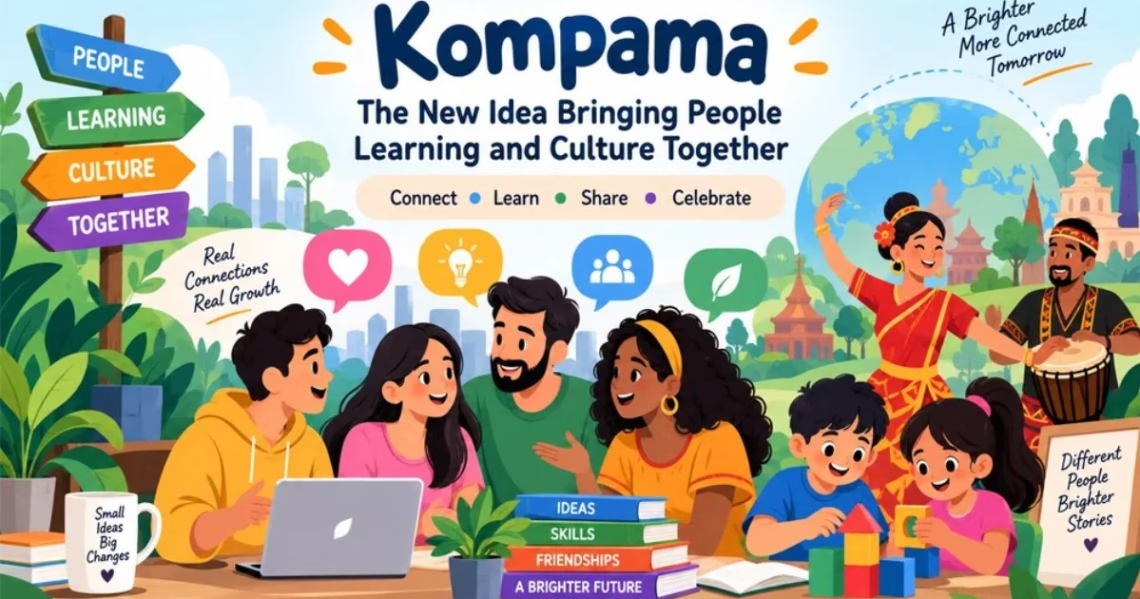
Kompama is an unusual term that has attracted curiosity among people searching for its meaning, background, and possible uses. Because it is not a commonly used English word, many readers want to understand what Kompama means, where it comes from, and why it appears in online discussions. The answer depends on the context in which the word is used.
One important detail is that Kompama is an Estonian verb associated with touching, feeling, or searching by hand. The idea can also be explained in a broader sense as exploring something through direct experience. At the same time, the word may appear in digital content as a name, label, or branding concept. These uses should not automatically be treated as evidence of an established company, application, or online service.
Understanding Kompama requires looking at its linguistic background, possible interpretations, practical examples, and growing relevance in online searches. This guide explains these aspects in simple language so readers can distinguish established meaning from possible modern applications.
Whether you encountered Kompama while researching an unfamiliar word, exploring language, studying branding, or browsing online, this article will help you understand the term and evaluate the information associated with it.
What Is Kompama?
Kompama is an Estonian verb that relates to touching, feeling, or searching for something with the hands. It describes an action in which a person uses physical contact to explore an object or understand its characteristics.
For example, imagine searching for a small item inside a bag without looking directly at it. You move your fingers around until you recognize the object. This is a simple way to understand the physical idea associated with Kompama.
The concept is connected to discovering information through interaction rather than relying entirely on sight or other sources.
However, the meaning of a word can change depending on how people use it. When Kompama appears in discussions about business, technology, personal development, or digital identity, it may be used more loosely as a name or a creative concept.
It is therefore useful to distinguish between three possibilities:
- Linguistic meaning: The word’s connection with touching, feeling, and exploring by hand in Estonian.
- Figurative interpretation: The broader idea of investigating something carefully or learning through experience.
- Name or branding usage: The possibility that a person, project, or business uses Kompama as an identifying name.
These categories are related, but they are not interchangeable. A word can have a documented meaning in one language and still be used as a name in a completely different setting.
For readers researching Kompama, the most reliable starting point is its linguistic meaning. Any additional claims about a particular service or product should be checked against information about that specific entity.
What Does Kompama Mean in English?
The closest simple English explanation of Kompama is to touch, feel, or explore something by hand. The exact translation depends on the sentence and the situation in which the word is used.
English does not always have a single word that captures every detail of a foreign-language verb. In some situations, the idea may be expressed as feeling around, feeling for something, or searching through touch.
Consider the following examples.
Example 1: Finding an object in the dark
A person enters a dark room and tries to find a light switch. They move their hand along the wall until they locate it. The action demonstrates how touch can help someone discover an object without seeing it clearly.
Example 2: Identifying a texture
Someone touches a piece of fabric to determine whether it feels soft, rough, thick, or smooth. They gather information through their sense of touch.
Example 3: Searching inside a bag
A traveler searches inside a backpack for a key. Instead of removing every item, they feel around until they recognize the key.
These examples help explain the physical idea behind the word. They are illustrative English-language situations, not claims that the word must be used in exactly the same way in every Estonian sentence.
The broader lesson is that language often describes how people interact with the world. Some verbs focus on seeing, hearing, or moving, while others describe how people use touch to understand their surroundings.
Kompama belongs to this area of meaning.
The Origin and Linguistic Background of Kompama
Understanding the background of Kompama helps explain why its meaning may be unfamiliar to English speakers.
Estonian is a Finnic language spoken primarily in Estonia. It has its own vocabulary, grammatical structures, and word forms that differ from English. As a result, a word that is ordinary in one language may appear unusual when encountered by someone who speaks another.
Kompama is associated with physical exploration through touch. Its meaning centers on an action rather than a physical object or a general category of things.
This distinction is important because verbs can be difficult to translate directly. A verb may describe not only what a person does but also how the action happens and what the person is trying to accomplish.
For example, English speakers might use different expressions depending on the situation:
- Feel around for an object.
- Search by touch.
- Explore a surface with the fingers.
- Try to identify something without looking.
These phrases communicate related ideas, but each emphasizes a slightly different aspect of the action.
Kompama is best understood through the sentence in which it appears rather than through an isolated translation alone.
Why the Original Language Matters
When researching an unfamiliar term, it is tempting to interpret it according to how it looks or sounds in English. However, spelling alone does not reliably reveal a word’s meaning.
A term may resemble an English word without sharing its origin. Similarly, a word that sounds like a brand name may actually be an ordinary word in another language.
Knowing that Kompama has an Estonian linguistic meaning helps prevent these misunderstandings.
It also demonstrates why language research should begin with the original context. If the word appears in an Estonian sentence, the surrounding grammar and subject matter can help clarify its meaning. If it appears as the name of a product or website, the relevant product information becomes more important.
Is Kompama an English Dictionary Word?
Kompama is not a common everyday English word. English speakers are more likely to encounter it through language research, online articles, or discussions about unfamiliar terms.
That does not mean the word has no meaning. It means its established linguistic background belongs to another language.
When readers search for Kompama in English, they should look for explanations that identify the original language and provide a clear translation rather than treating the word as an established English expression.
Why Are People Searching for Kompama?
There can be several reasons why someone searches for an unfamiliar term such as Kompama. A search does not always indicate that a word belongs to a popular product or a widely used digital service.
Sometimes people simply want to understand something they have encountered online.
Curiosity About an Unfamiliar Word
The simplest reason is curiosity. A reader might see Kompama in an article, a social media post, a discussion, or a search result and want to know what it means.
When a word is uncommon in English, even a brief appearance can lead to a dedicated search.
People may ask whether it is a foreign word, a name, an abbreviation, or a newly created expression. A useful explanation should address these possibilities without assuming that one interpretation applies everywhere.
Interest in Language and Translation
Students, language learners, translators, and researchers often search for words from languages they do not speak fluently.
Kompama may interest readers who are studying Estonian vocabulary or comparing how different languages describe physical actions.
For these users, a translation alone may not be sufficient. They may also want examples, contextual explanations, and clarification about how the word differs from related English expressions.
Exposure Through Online Content
Search interest can also arise when a term appears in digital publishing. An article, social media discussion, or search result may introduce an unfamiliar name to a wider audience.
Once people encounter the term, they may search for a more detailed explanation.
However, the appearance of a word across several websites does not necessarily establish that it represents a popular service or an emerging technology. Multiple pages may discuss the same term for different reasons.
Research Into Names and Branding
Some readers may encounter Kompama while looking for distinctive names for a business, project, application, or creative idea.
Unusual words can attract attention because they are different from familiar expressions. A short, distinctive name may be easier to recognize when it is used consistently.
Still, anyone considering Kompama for commercial use should check existing businesses, trademarks, domain availability, and relevant cultural meanings before making a decision.
Kompama as a Concept of Exploration
Beyond its direct linguistic meaning, Kompama can be used as a starting point for discussing exploration and discovery. This is a broader interpretation inspired by the idea of learning through touch, not a separate official definition.
Exploration is a basic part of human learning. People discover new information by observing their surroundings, testing ideas, asking questions, and interacting with objects.
Touch is one of the ways people gather information. A person can learn about the shape, texture, temperature, or firmness of an object through physical contact.
The same general principle of exploration can also be applied metaphorically to learning and problem-solving.
For example, someone entering a new workplace may need time to understand its routines. A student learning a difficult subject may experiment with different study methods. A business testing a new product may gather feedback before making a larger investment.
In each situation, understanding develops through interaction and observation.
These examples illustrate a possible conceptual connection. They should not be confused with proof that Kompama is an established productivity method or a formally recognized business framework.
Exploration Through Observation
Before taking action, people often observe their surroundings and identify what they already know.
Observation helps establish a starting point. It allows someone to notice patterns, identify questions, and determine what additional information is needed.
For example, a student beginning a research project may first review the available material. A business owner may examine customer feedback before changing a product.
Careful observation can reduce unnecessary mistakes and make the next steps more effective.
Learning Through Direct Experience
Reading and listening are valuable, but direct experience can reveal information that is difficult to understand through descriptions alone.
A person learning to use a new tool may understand its basic instructions before discovering how it works in practice. Experimentation helps connect theoretical knowledge with real situations.
This is particularly useful when the outcome depends on individual circumstances.
Adjusting Based on New Information
Exploration does not always produce an immediate answer. Sometimes an initial attempt reveals that an assumption was incorrect or that more information is needed.
A practical approach is to review the result, adjust the method, and try again.
This process applies to many everyday activities, from learning a skill to solving a technical problem.
The connection with Kompama is conceptual: both the linguistic idea of exploration through touch and the broader process of discovery involve gathering information through interaction.
Possible Uses of Kompama in Modern Branding
Kompama may also be considered as a distinctive name for a project or brand. This is a potential use of the word, not evidence that a particular Kompama business or product already exists.
Businesses frequently search for names that are memorable, recognizable, and suitable for their intended audience.
A distinctive name can help a company establish its identity, especially when it is used consistently across its website, product materials, and communications.
However, an unusual name is not automatically a successful brand. Its value depends on the product, audience, positioning, and overall customer experience.
Technology and Software Projects
A developer creating a new application might consider an unfamiliar word because it gives the product a recognizable identity.
For example, a hypothetical software project could use a distinctive name for an educational application, research tool, or organizational system.
Before adopting the name Kompama for such a project, the developer would need to establish what the product does and determine whether the name is available for commercial use.
A name alone does not prove that a software platform exists.
Educational Initiatives
An educational project may choose a memorable name for a learning program, classroom activity, or language resource.
If the project focuses on discovery, experimentation, or hands-on learning, the broader idea associated with Kompama might provide inspiration for its identity.
The name would still need to be explained clearly to the intended audience.
Creative and Media Projects
Writers, artists, designers, and independent creators sometimes use uncommon words for books, collections, creative projects, or digital publications.
A distinctive term can create curiosity, but the creator must also help audiences understand what the project represents.
Good branding combines a recognizable name with a clear purpose.
Business Naming Considerations
Anyone considering Kompama as a brand name should evaluate several factors:
- Meaning: Understand the word’s original linguistic meaning.
- Pronunciation: Determine whether the intended audience can say it comfortably.
- Recognition: Consider whether people can remember and spell it.
- Availability: Investigate relevant trademarks, domains, and existing businesses.
- Cultural context: Check whether the name has additional meanings or associations in target markets.
- Audience fit: Make sure the name suits the product, service, or organization.
These checks can help prevent confusion and reduce the risk of choosing a name that conflicts with an existing identity.
Kompama and Digital Identity
Digital identity refers to the way a person, organization, product, or project is represented online.
A name can become part of that identity through its use on websites, profiles, applications, publications, and other digital materials.
If Kompama is used as an online name, its meaning will depend partly on the identity attached to it. One person might use it for a creative project, while another could use the same or a similar term for an unrelated purpose.
This is why context matters when researching unfamiliar names.
How to Identify the Correct Meaning
When encountering Kompama online, start by examining the surrounding information.
Ask the following questions:
- Is the word used in a sentence written in Estonian?
- Is it presented as a business or product name?
- Is there an identifiable organization associated with it?
- Does the page provide specific details about the claimed service?
- Is the explanation supported by information that can be independently checked?
These questions help separate linguistic information from commercial claims.
If a page describes Kompama as an application, for example, readers should look for evidence such as an identifiable developer, official product information, a clear description of its features, and relevant terms or privacy information.
Without that evidence, it is better to treat the claim as unverified.
Why Context Prevents Confusion
A single word can appear in different settings without referring to the same thing.
For example, an ordinary word may be used as a brand name even though its original meaning remains unchanged. A newly created product name may also resemble an existing word from another language.
Readers who ignore context may accidentally combine unrelated meanings or assume that every mention refers to one organization.
A careful explanation should identify what is established, what is a possible interpretation, and what still needs verification.
Is Kompama a Website, Application, or Digital Platform?
This is an important question for readers who have encountered Kompama through online searches.
The word’s linguistic meaning does not establish that it is a website, application, or digital platform. A separate product or service may use the same name, but that possibility requires specific evidence.
It is therefore inaccurate to assume that Kompama automatically refers to a particular digital service.
To verify a claimed platform, readers should look for several basic details.
Official Product Information
A legitimate service should have identifiable information explaining what it offers and who operates it.
Depending on the type of service, this may include an official product description, company details, support information, and documentation.
The absence of these details does not automatically prove that a service is illegitimate, but it makes verification more difficult.
Features and Functionality
A product description should explain what users can actually do with the service.
For software, this could include supported devices, available tools, account requirements, pricing, or technical limitations.
General statements about innovation or convenience are not enough to establish specific functionality.
Security and Privacy
If a claimed service asks users to register, provide personal information, upload files, or make payments, its privacy and security practices deserve attention.
Readers should review the information available before sharing sensitive details.
They should also avoid downloading unfamiliar files or installing software from unverified sources.
Independent Verification
Information from the operator can be useful, but readers should look for additional evidence when making important decisions.
Relevant evidence may include credible reviews, identifiable business information, technical documentation, or consistent details from independent sources.
Until these checks establish what a particular service does, its features and reputation should not be presented as confirmed facts.
Read more: Kecalf Cunningham: Biography, Age, Parents, Wife, Children, Music Career, and Family Legacy
Potential Advantages of a Distinctive Name Like Kompama
When used as a name, Kompama has characteristics that may appeal to people seeking an original identity. These are general advantages of distinctive naming, not verified benefits of an existing Kompama product.
Memorability
An unfamiliar word can stand out because it differs from ordinary expressions.
If the word is easy to pronounce and consistently associated with one project, people may gradually learn to recognize it.
However, unusual spelling can also create difficulties. Potential customers may struggle to remember the name or type it correctly.
Differentiation
A distinctive name may help a project stand apart from competitors with similar naming styles.
This is especially relevant in crowded industries where many products use descriptive names.
Effective differentiation requires more than originality. The brand must also offer a clear purpose and a meaningful experience.
Flexible Positioning
A newly selected name may provide room for a brand to develop its identity over time.
For example, a company may initially offer one product and later expand into related services. A flexible name can sometimes accommodate that growth.
The business should still ensure that its name communicates an appropriate impression to its audience.
Recognition Through Consistency
Repeated use of the same name, logo, message, and visual identity can help audiences connect different materials with the same organization.
Consistency can make it easier for customers to recognize a brand across multiple channels.
However, recognition develops through repeated exposure and a reliable experience. It cannot be guaranteed simply by choosing an unusual word.
Limitations and Misunderstandings About Kompama
Because Kompama is unfamiliar to many English speakers, several misconceptions may arise.
Understanding these limitations helps readers evaluate information more accurately.
Assuming Every Mention Refers to the Same Entity
The word may appear in language discussions, creative projects, or branding contexts.
Not every use necessarily refers to one company or product. Readers should examine the context before drawing conclusions.
Treating Speculation as Established Information
Online articles sometimes describe possible uses of an unfamiliar word in confident language.
For example, a page might suggest that a term could be suitable for an application or business. That does not prove that such an application or business exists.
The distinction between a possibility and a verified fact is essential.
Assuming the Word Has an Official English Definition
Kompama has a linguistic meaning associated with Estonian, but it is not a common English vocabulary item.
English-language explanations should communicate the original meaning instead of inventing a definition simply because the word looks like a product name.
Believing That Unusual Names Guarantee Success
An original name may help with recognition, but it cannot replace a useful product, a good customer experience, or effective communication.
A successful project needs a clear purpose and evidence that it meets its audience’s needs.
Assuming That Search Visibility Proves Popularity
A word can appear in search results because publishers have written about it.
That visibility does not necessarily show how many people use a related product, whether a service has many customers, or whether a term is becoming popular in everyday speech.
Reliable conclusions require more than the number of pages discussing a word.
How to Research Kompama Effectively
If you want a clearer understanding of Kompama, use a research process that separates language, context, and claims about products.
Start With the Original Meaning
Begin by identifying the language associated with the word.
For Kompama, the Estonian connection provides a useful starting point. Understanding the original meaning helps prevent confusion with unrelated uses.
Examine the Sentence or Page
Read the surrounding text rather than relying on a heading alone.
A sentence can reveal whether the word is being used as a verb, a name, or a general concept.
If the page makes a claim about a company or service, identify the specific entity before accepting the description.
Check the Evidence
Look for information that supports the claim being made.
For linguistic questions, this may include reputable dictionaries or language references. For a product, it may include official documentation and independently verifiable details.
The appropriate evidence depends on the question being asked.
Compare Interpretations Carefully
If different explanations appear online, determine whether they are actually describing the same thing.
One explanation may discuss the Estonian word, while another may discuss a hypothetical brand name. These interpretations can coexist without being contradictory.
Avoid Unsupported Conclusions
If the available information does not establish that Kompama is a specific company or platform, say so.
Acknowledging uncertainty is more useful than filling gaps with invented features, user statistics, launch dates, or business claims.
This approach creates a clearer understanding of the term and helps readers make better decisions.
Kompama in the Future: What Can Be Expected?
The future use of Kompama depends on the context in which the word appears.
As a linguistic term, its meaning can be explored through Estonian language learning, translation, and related vocabulary.
As a possible brand name, its future would depend on whether an individual or organization adopts it and develops a recognizable identity.
As a conceptual inspiration, it may be used to discuss exploration, hands-on learning, and discovering information through experience.
These possibilities should remain separate from predictions about a specific product or company that has not been verified.
Language and Learning
Unfamiliar words can attract attention because they introduce readers to new ways of expressing ideas.
Studying Kompama may encourage people to explore Estonian vocabulary and consider how different languages describe similar experiences.
Branding and Creative Work
If someone chooses Kompama for a project, its distinctiveness could become part of the project’s identity.
The success of that choice would depend on the project’s purpose, audience, communication, and long-term consistency.
Online Information
As more content about unfamiliar words appears online, accurate explanations become increasingly important.
Readers benefit when articles explain the original meaning, identify uncertainty, and avoid presenting assumptions as verified information.
Ultimately, the future significance of Kompama will depend on how the word is used and what reliable evidence becomes available about those uses.
Frequently Asked Questions About Kompama
What is Kompama?
Kompama is an Estonian verb associated with touching, feeling, or searching by hand. The word may also appear in other contexts as a name or label, so its precise interpretation depends on how it is used.
What does Kompama mean in English?
A simple English explanation is to touch, feel, or explore something by hand. Depending on the context, related expressions may include feeling around or searching by touch.
Which language does Kompama come from?
Kompama is associated with the Estonian language. Its linguistic meaning relates to physical exploration through touch.
Is Kompama an English word?
Kompama is not a common everyday English word. English speakers may encounter it while researching Estonian vocabulary, unfamiliar names, or online discussions.
Is Kompama a website?
The word itself does not establish that a website exists. If you encounter a website using this name, verify its identity and purpose through reliable information about that specific service.
Is Kompama an application?
There is no basis for concluding that every use of Kompama refers to an application. A product may use the name, but its existence and features should be verified separately.
Why is Kompama appearing in online searches?
People may search for Kompama because they encountered the word in an article, want its translation, or are researching a name or concept. Search visibility alone does not establish that a related product is widely used.
Can Kompama be used as a brand name?
Potentially, yes. An individual or business could consider it as a distinctive name, provided it is suitable for the intended audience and available for lawful use. Trademark and existing-brand checks are important before commercial adoption.
Does Kompama have a symbolic meaning?
Its documented linguistic meaning relates to touching and exploring by hand. People may use that idea symbolically to discuss discovery or learning through experience, but such interpretations should be identified as conceptual rather than official definitions.
Is Kompama a technology or artificial intelligence tool?
The word’s meaning does not prove that it refers to a technology or artificial intelligence tool. Any claim about a specific product should be supported by identifiable information about that product.
Is Kompama safe to use?
The answer depends on what you mean by use. Learning the word or using it in writing is different from downloading software or registering for an online service. If a service uses this name, evaluate its identity, privacy practices, and security before sharing personal information.
How can I find accurate information about Kompama?
Start with its linguistic meaning, examine the context in which you encountered it, and verify any additional claims using relevant evidence. If the word is presented as a product name, look for reliable details about the particular product rather than assuming that every mention refers to the same entity.
Is Kompama a popular term?
Its appearance in online content does not, by itself, establish widespread use or popularity. Reliable search-volume data, linguistic evidence, or independently verified adoption would be needed to support a stronger claim.
What is the difference between Kompama’s meaning and its possible brand use?
Its linguistic meaning is connected to touching, feeling, and searching by hand in Estonian. Its possible brand use would be a separate application of the word as a name. The original meaning does not automatically describe the features or purpose of a product using that name.
Final Thoughts on Kompama
Kompama is an interesting term because it connects a specific linguistic meaning with the broader ways unfamiliar words can appear in modern online discussions.
Its Estonian meaning relates to touching, feeling, and searching by hand. This provides a clear starting point for understanding the word and its connection to physical exploration. The same idea can inspire broader discussions about discovery, practical learning, and gathering information through experience, although those broader interpretations should not be mistaken for separate official definitions.
Kompama may also be considered as a distinctive name for a creative project or business. However, using a word as a brand is different from establishing that a particular company, website, application, or digital platform already exists.
The best way to understand Kompama is to consider the context, check the evidence, and distinguish established information from possible interpretations.
For language learners, it offers an opportunity to explore Estonian vocabulary. For researchers, it demonstrates why uncommon keywords require careful verification. For anyone considering it as a name, it highlights the importance of originality, audience understanding, and appropriate checks before commercial use.
Ultimately, Kompama is best approached with curiosity and accuracy. Understanding what a word means, where it comes from, and how it is being used provides a much stronger foundation than relying on assumptions or unverified online claims.





One comment on “Kompama: Meaning, Origins, Uses, and Everything You Should Know”